Concrete project planning in Camas, WA requires defining the use of the project, dimensions, site details, drainage, and desired finish before the price is quoted. An adequate plan would give Concrete Contractors in Camas a lot of details to properly estimate the work and prevent expensive rework due to unforeseen problems.
1. Determine What It Is You Plan to Build
First and foremost, you need to identify the true nature of your concrete project.
There is the concrete walkway, the patio, the driveway, and the concrete slab, each one requiring a distinct approach to planning.
List the following details:
- Usage of concrete structure
- Dimensions
- Amount of expected traffic – pedestrian or vehicular
- Desired finish
- Site access
- Drainage considerations
- Timing of the project
For instance, there is a huge difference between a concrete residential walkway and a driveway that would be used regularly by cars.
It’s a simple and practical starting point for Concrete Contractors.
2. Measure the Project Area
It is important to have precise calculations because concrete is usually calculated by volume, rather than by surface area.
Calculate the area that will be covered by measuring its length and width.
Consider also the thickness of your slab.
Volume for a slab in rectangular form will be:
Length x Width x Thickness = Concrete Volume
Thickness should not be chosen only due to its cost.
The right one will depend on how you will use your slab, site specifics, soil conditions, the need for reinforcement, and construction practices.
It should be checked with the help of a professional.
3. Examine the Existing Ground
The ground underneath concrete is as important as concrete itself.
Check before laying if there are:
- Sloppy or disturbed soil
- Any cracks
- Water spots
- Bad drainage system
- Roots
- Fills
- Utility clashes
- Places of settlement
- It is not possible to correct bad ground with concrete.
If inappropriate material is left under your slab, it may cause cracks or settling issues, despite the beauty of the surface that will appear at the beginning.
That is why skilled professionals from Concrete Contractors pay attention to examining sites before pouring concrete.
4. Think About Camas Weather and Drainage
There is plenty of rainfall in Camas; therefore, water management needs to be a part of the planning process.
It is not only about having a completely flat concrete slab.
Water should find a proper way to go, and it shouldn’t flow towards places where it can cause drainage or foundation issues.
Questions for the contractor:
- Where will surface water go?
- Is there a need for grade correction?
- Do we need any drains?
- Should there be some slope on the slab?
- What will happen to the water near other structures?
The perfect-looking patio that constantly has water on it is not a successful concrete job.
5. Check Permits and Local Requirements
Do not assume every concrete project has the same permit requirements.
Camas provides permitting and development information through its Community Development Department, which includes planning, development engineering, and building functions.
Before work begins, determine whether your project requires a permit, inspection, right-of-way approval, or other local review.
This is especially important when the work involves structural changes, significant site development, or areas connected to public infrastructure.
Confirm requirements for your specific property rather than relying on advice from an unrelated project.
6. Choose a Qualified Contractor
The contractor you hire affects the quality of both the installation and the planning process.
In Washington, construction contractors generally must be registered with the Department of Labor & Industries and meet applicable bonding and insurance requirements.
When comparing Concrete Contractors in Camas, ask for the contractor registration information and verify it rather than assuming an online advertisement proves registration.
You can also ask:
- How long have you performed this type of work?
- Can you show comparable projects?
- Who will perform the installation?
- How is the base prepared?
- What reinforcement is planned?
- How are control joints determined?
- What curing process will be used?
- How will drainage be handled?
- What exactly is included in the estimate?
Specific answers are more useful than general promises.
7. Compare Quotes Properly
The lowest quote is not necessarily the lowest project cost.
Two quotes may have different costs because they contain different amounts of work.
Consider:
- Demolition
- Excavation
- Site preparation
- Reinforcement
- Concrete thickness
- Concrete mixture
- Finishing
- Control joints
- Sealant
- Cleanup
- Disposal
- Work required for permits
- Improved drainage
Have the contractors explain any significant differences in cost.
If a quote does not take into account the need for site preparation, it may look cheap until further work is realized.
8. Select the Finishing Touch
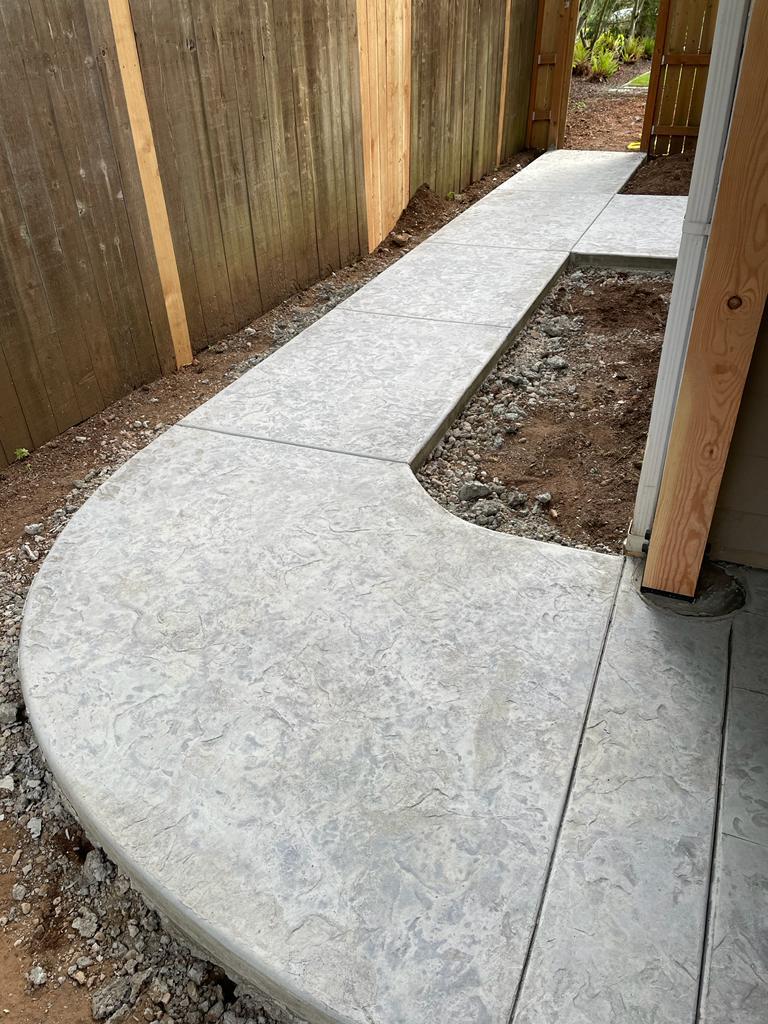
Concrete does not have to be functional but ugly.
Depending on the intended use, you could consider:
Broom finish
Smooth finish
Exposed aggregate
Decorative finish
Stamped concrete
Colored concrete
Select the finish based on location.
If you are building a walkway or driveway outside your home, function should be considered as important as aesthetics.
For a patio, decorative finishes are better choices, considering that aesthetics play a bigger role in the project.
9. Plan Control Joints and Cracking
Volume variation is inherent in concrete curing and temperature change.
This is precisely why control joints should be planned for.
We do not guarantee that concrete will never crack. A professional contractor should inform you that it could crack and show you how it will be handled during installation.
Inquire where joints will be installed and why.
Watch out for contractors who tout concrete as the one material that will never crack under any condition.
10. Know the Curing Time
Even when concrete is hard to touch, that doesn’t mean it is ready for use.
Curing is very important in building strength. How long should one wait before the load is introduced?
These would depend on your contractor and your own case.
11. Consider Access Before Pour Day
Concrete jobs require logistics.
Think about:
- Access for delivery trucks
- Placement of equipment
- Whether or not temporary vehicle access is needed
- What will happen to excavated materials
- Impact to adjacent properties
- Placement of the workforce
Restricted access may affect the cost and method of concrete installation.
Discuss this prior to scheduling the job rather than during.
12. Keep the Written Scope Clear
A good contract should make the project understandable.
It should identify the work being performed, major materials, pricing, payment terms, and other relevant responsibilities.
Keep copies of:
- Contract
- Estimate
- Change orders
- Permit documentation
- Product information
- Warranty information
- Payment records
If something changes during construction, document the change rather than relying only on a verbal agreement.
Why Planning Matters More Than the Pour
Why The Pour Is Less Important Than The Plan
Most people think first about how it will look when the concrete pour is done.
The real question is how it will perform in the years that follow.
Good concrete construction starts well before the truck arrives. The site, the drainage, the specifications, access, and craftsmanship all factor into the result.
When working at Xcelent Concrete Services, we should strive to treat each job as a complete building process rather than just a concrete deliverer. For the Camas concrete projects you are considering, make sure you ask a lot of questions before basing your choice on cost alone.
FAQs
How far ahead of time should I start planning a concrete project in Camas?
You should plan far enough ahead to assess the site, review the contractors, and understand the permitting and construction conditions involved.
What should be included in a concrete estimate?
All relevant factors related to the particular project.
Do I need a permit for a concrete project in Camas?
Permit requirements vary by project. Check with the City of Camas Community Development Department before starting work.
How do I choose between Concrete Contractors?
Compare registration, experience with similar projects, site preparation, scope, materials, drainage planning, and written pricing rather than choosing solely on the lowest quote.
Can concrete be guaranteed not to crack?
No responsible contractor should promise that concrete will never crack. Proper design, base preparation, jointing, curing, and maintenance can help manage cracking risk, but concrete remains a construction material subject to environmental and site conditions.
What is the biggest planning mistake homeowners make?
Treating concrete as only a surface material. The ground preparation, drainage, and project design underneath the finished surface are equally important.