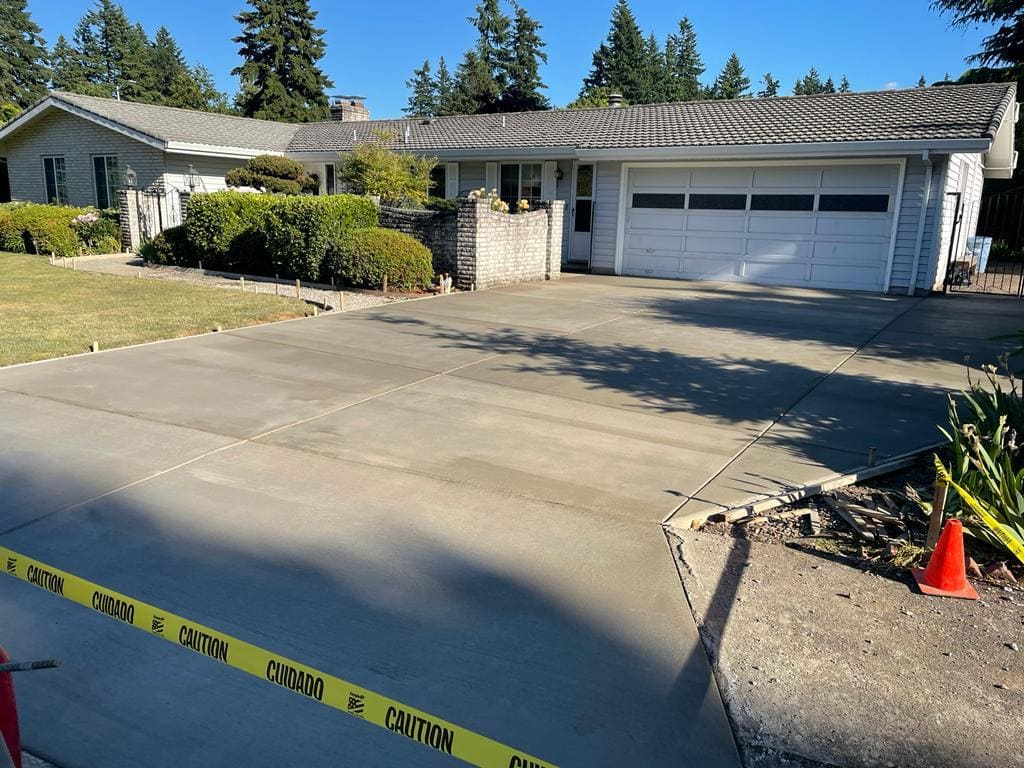
Okay—picture this: You’ve just spent thousands of dollars on a brand-new concrete driveway. It looks amazing. Smooth. Solid. Like something outta a magazine.
But then, just six months later? Cracks. Little chips. Maybe even some weird sinking in the middle.
Yeah… that happens a lot more than you’d think. And one big reason why?
You guessed it: The concrete wasn’t thick enough.
Let’s get into it—the real talk version. We’re gonna answer the question:
How thick should a concrete driveway be… and what actually happens if you don’t get it right?
The Short (But Important) Answer: 4″ to 6″ Is Usually the Sweet Spot
Concrete driveway thickness guide for Portland drivewaysMost of the time—for regular ol’ driveways in Portland—4 inches of concrete is the standard go-to.
But hold up.
If your driveway’s gonna support heavier stuff like delivery vans, an RV, maybe a work truck or trailer? You’ll probably wanna beef it up to 5 or even 6 inches.
Why Concrete Thickness Matters
Concrete can appear to be rock-hard, yet it relies heavily on being poured and cured correctly and, most importantly, on its thickness. Thickness is crucial in bearing the load of cars, resisting cracks, and enduring changes in weather.
Too thin, and your driveway will break and flake under pressure. It’s too thick, and you might be shelling out more money than you need to. That’s why finding the middle ground is important.
Industry Standard Thickness for Residential Concrete Driveways
For the average standard passenger car, the industry-standard thickness of a concrete driveway is 4 inches. This is the industry standard that optimizes strength versus cost.
But if your driveway will frequently withstand heavier loads such as trucks, RVs, or trailers, a thickness of 5 to 6 inches is usually recommended. This gives extra structural strength to endure more weight without early collapse.
Pro Tip: Always make sure the concrete is reinforced with steel rebar or wire mesh, particularly if you are using thicker slabs. Reinforcement adds strength and minimizes cracking.
Factors That Affect Driveway Thickness
While 4 to 6 inches is a rule of thumb, a number of factors can influence the optimal thickness of your concrete driveway:
1. Soil Conditions
The soil under your driveway has a huge impact on stability. If soil is loose or inadequately compacted, it might shift, leading to cracks or unevenness. Your contractor could suggest a thicker slab or further base preparation in this situation.
2. Drainage
Incorrect drainage may result in erosion beneath the driveway, undermining its base. An experienced Concrete Driveway Repair Contractor in Portland will assess the slope and water flow to suggest changes that may affect thickness.
3. Weather
Portland has rainy, cold winters, which cause concrete to expand and contract. A marginally thicker slab with adequate curing and control joints can reduce weather-induced damage.
4. Vehicle Weight and Traffic Volume
A simple residential driveway for automobiles is different from one that services commercial vehicles or multiple uses per day. The heavier and more wear, the thicker the concrete needs to be.
How to Get It Done Correctly
Hiring qualified Portland concrete contractors is the key to having the job performed correctly. This is what a professional contractor will usually do:
Site Assessment
Assessing soil conditions, grade, and vehicle load requirements.
Base Preparation
Compacting base gravel or sand to bear the slab.
Form Setup
Properly aligned and level forms for the specified thickness.
Reinforcement Installation
Installing rebar or mesh as necessary.
Correct Pouring Techniques
Employing quality concrete mix and equipment.
Curing
Permitting proper curing time (typically 7 days minimum) to avoid premature cracking.
When Is Driveway Repair or Replacement Required?
Even the best installation driveways can be damaged over time because of wear, freeze-thaw action, or ground movement. Some of the usual signs that you will require repair or replacement are:
- Large holes or cracks
- Sinking or uneven surfaces
- Flaking or scaling of surfaces
- Pooling water
If you’re seeing these symptoms, talk to Concrete Driveway Contractors so you can determine whether repair or total replacement will be best. Surface cracks are simple enough to repair, but severe structural flaws may necessitate a new pour and possibly a thickness change in the slab.
Rely on Local Experts for Guaranteed Results
With Xcelent Concrete Services we put forward how it should go across in the psyche of any homeowner that the driveway is nothing but an investment in the safety and security of the whole premise. Years of real-world application, together with the highest-quality materials, come ironically into play with us to breathe life into your concrete driveway and the commitment to look into every detail.
Whether you’re installing a new driveway or thinking about concrete driveway repairs, our crew offers simple solutions and rock-and-roll expertise just right for the particular Portland conditions.
Final Thoughts
how thick should a concrete driveway be? Are you frustrated with the experience of a below-average concrete contractor? Call Xcelent Concrete Services today- your trusted source for Portland concrete driveway work.
FAQs
1. What is the standard thickness for a concrete driveway?
The standard thickness is 4 inches for most residential driveways. For heavier vehicles like trucks or RVs, 5–6 inches is recommended.
2. Does driveway thickness affect durability?
Yes, thicker concrete provides better strength, load capacity, and resistance to cracking, making your driveway last longer.
3. Is 3 inches of concrete enough for a driveway?
No, 3 inches is generally too thin and may crack under normal vehicle weight. It’s not recommended for long-term use.
4. Do I need a thicker driveway for heavy vehicles?
Yes, if you park heavy vehicles, a thickness of 5–6 inches with proper reinforcement is ideal to prevent damage.5. What else is important besides thickness?
A strong base, proper reinforcement (rebar or wire mesh), and good drainage are just as important as thickness for a durable driveway.