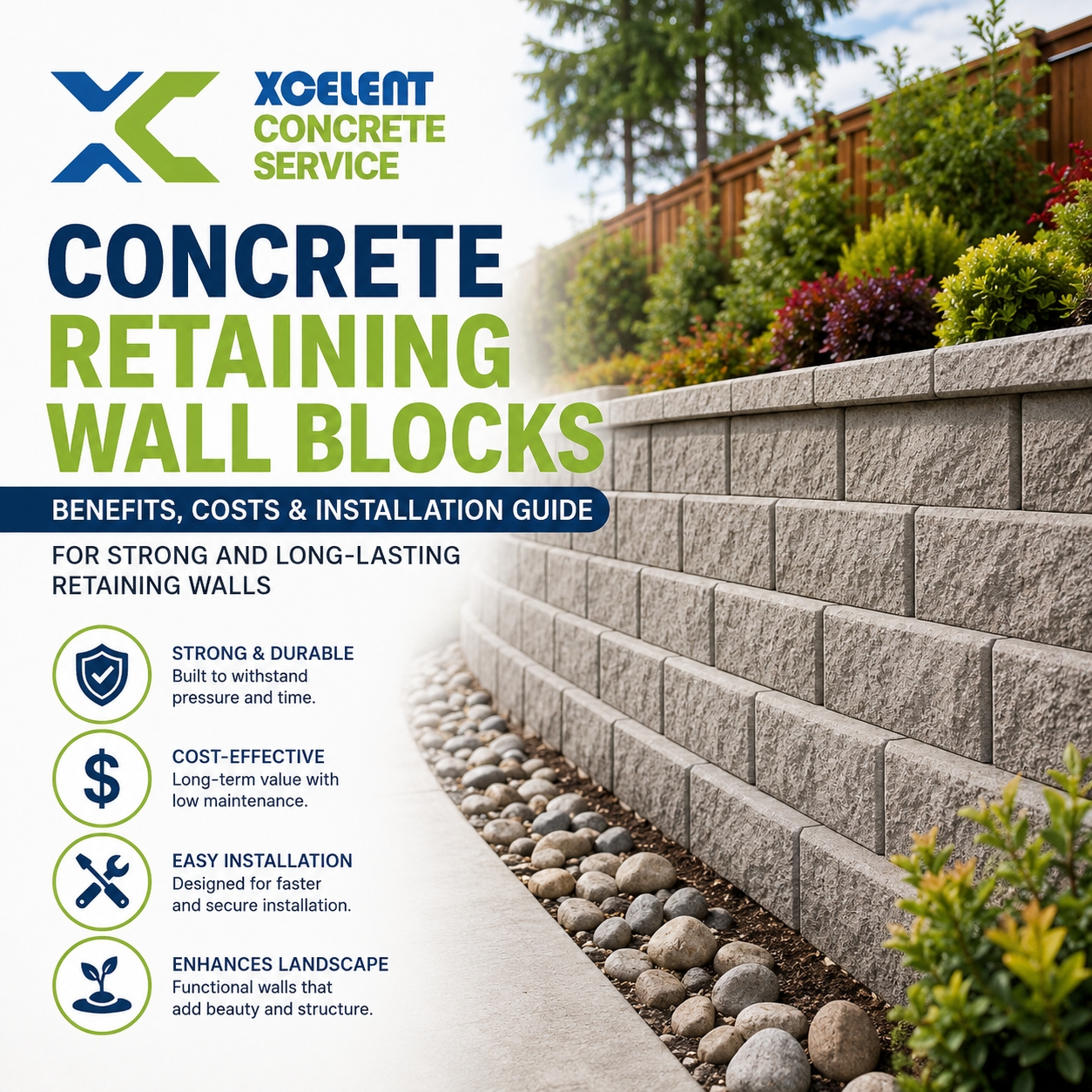
One of the most resilient and inexpensive options for creating robust retaining walls is concrete retaining wall blocks. They provide excellent strength, long life, visual appearance, and reduce soil erosion and land movement. When installed correctly, a concrete block retaining wall can last for decades with minimal maintenance.
Why Concrete Retaining Wall Blocks Are a Popular Choice
Concrete Retaining Wall Blocks are a popular choice for a variety of reasons. There are several reasons why Concrete Retaining Wall Blocks are a popular choice.
Retaining walls are a vital and useful part of any landscape, whether residential or commercial. They are used to control erosion, manage sloped ground, and provide usable space for outside use. Today, there are numerous materials that are available, but one of the most popular choices is the concrete retaining wall blocks.
If you’re thinking of an improvement project in your backyard or you want to install a larger retaining wall for your business, it’s important to know the pros and cons and how to do it.
What are Concrete Retaining Wall Blocks?
Concrete Retaining Wall Blocks are a type of concrete block that is specially made for use in retaining and supporting soil. Retaining wall blocks are designed to accept lateral soil pressure, while concrete masonry blocks are not.
Many modern block systems have interlocking characteristics that make installation easier and provide a more stable wall.
The block that is made of concrete can be used for:
- Garden retaining walls
- Landscape terraces
- Raised planting beds
- Commercial retaining structures
- Driveway support walls
- Slope stabilization projects
These blocks come in various sizes, textures, and colors, offering homeowners and craftsmen the ability to construct beautiful and useful retaining walls.
Key Benefits of Concrete Retaining Wall Blocks
Concrete retaining wall blocks offer many benefits.
Super strength and durability
The major benefit of concrete retaining wall blocks is their strength.
Concrete is a material that is used to construct buildings and structures that are designed to withstand the effects of the environment and the weight of the surrounding terrain. A well-constructed wall will handle the soil pressure, weather conditions, and moisture for many years.
Concrete Block retaining walls are extremely stable and can last for decades.
Long Service Life
When properly installed and properly maintained, a concrete block retaining wall can last for 50 years or longer.
Concrete blocks don’t rot over time like wood retaining walls do:
- Decay
- Insect damage
- Moisture-related deterioration
- Fire damage
This ensures that they are a good investment for the long term.
Attractive Appearance
There are many different finishes and styles of modern retaining wall systems.
You can select blocks that look like:
- Natural stone
- Split-face rock
- Textured masonry
- Architectural concrete
This versatility enables retaining walls to blend in with various landscape designs.
Easy Maintenance
Retaining walls made from concrete are basically maintenance-free.
In most situations, the maintenance will include:
- Periodic cleaning
- Inspecting drainage systems
- Removing vegetation growth
No need to stain or seal it, or to make frequent repairs.
Cost-Effective Solution
The cost of installing concrete retaining wall blocks differs, but they can be very cost-effective over the years.
They last longer thus lowering the costs for repairs and replacements as well, which makes them a wise choice for many projects.
Average Cost of a Concrete Block Retaining Wall
The price of a concrete block retaining wall is dependent upon several factors:
- Wall height
- Wall length
- Site conditions
- Drainage requirements
- Excavation needs
- Block style and quality
- Labor costs
Typically, the bigger the home and the more engineering is needed, the more expensive the costs will be.
If walls are more than a certain height, they may need professional engineering, permits, and reinforcement systems.
The best way to calculate the approximate cost of a project is to ask an experienced concrete contractor to come out and do an inspection.
How Concrete Retaining Wall Blocks Are Installed
A retaining wall that is properly installed is going to last a long time.
Here is a basic explanation of the process that the professionals use.
Conduct a site assessment and plan.
Step 1: Site Assessment & Planning
The site needs to be assessed before construction.
Key considerations include:
- Soil conditions
- Drainage patterns
- Slope angle
- Wall height
- Local building requirements
Planning can be used to avoid future structural problems.
Step 2: Excavation
The excavation is made that allows for the placement of the wall foundation.
- The trench should be at least as wide and deep as the base and first course of blocks.
- Good excavation is one of the most significant contributing factors to wall stability.
Step 3: Base Preparation
The trench bottom is filled with a compacted aggregate base.
This base helps:
- Distribute weight evenly
- Improve drainage
- Reduce settlement
- Increase wall stability
The contractor is careful to compact the base material to provide a solid foundation.
Step 4: Installing the First Row
The first row of concrete retaining wall blocks is set on the prepared base.
This row has to be perfectly level, as all of the blocks above will rely on it for alignment.
Even if a small mistake is made at this point, it can impact the whole wall.
Step 5: Building the Wall
Other rows are placed on top of each other as per the manufacturer’s instructions.
Interlocking mechanisms are used in many systems to aid in securing the interlocks.
As progress is made, the following is verified on each row:
- Levelness
- Alignment
- Proper setback
- Installation of backfilling and drainage.
Step 6: Backfilling and Drainage Installation
A wall that traps water behind it can generate substantial pressure and result in failure.
Professional installations usually consist of:
- Drainage aggregate
- Perforated drain pipe
- Filter fabric
Good drainage helps prolong wall life and minimises maintenance requirements.
Step 7: Final Grading and Finishing.
After the wall is finished, the surrounding area is graded and finished.
This will make it easier to drain, and it will look neat and professional.
Common Mistakes to Avoid
A lot of retaining wall collapses are due to installation mistakes.
Common mistakes include:
Poor Drainage
One of the most common reasons for problems with retaining walls is due to water pressure.
- Always have a suitable drainage system.
Inadequate Base Preparation
Inadequate compaction or the use of an unsuitable base material may cause movement and settlement in walls.
- Without proper planning, building is not possible.
- Engineering calculations and permits may be needed for taller walls.
- Failure to comply with these requirements may lead to structural problems and code violations.
The use of inappropriate materials
- Not every concrete block will be suitable for a retaining wall.
- Look for block products designed to be used as concrete retaining wall blocks.
Why Professional Installation Matters
Some small ones can be done in the home, but larger retaining walls are best constructed by a professional.
Experienced contractors understand:
- Soil behavior
- Drainage design
- Load requirements
- Local regulations
- Proper construction methods
Our team at Xcelent Concrete Services is experienced in the construction of retaining walls that are built to last. With proper planning, quality materials, and skilled installation, every wall can provide value for a long time.
Final Thoughts
Concrete retaining wall blocks continue to be one of the most effective ways to build long-lasting, aesthetic, and stable retaining walls. They are strong, easy to maintain, and flexible in design, making them ideal for both residential and commercial applications.
Whether you are looking for a small garden wall or a large structural retaining wall system, a professionally installed concrete block retaining wall can provide many years of support for your property, enhanced functionality, and curb appeal.
Trust Xcelent Concrete Services to build strong, durable retaining walls that stand the test of time. Contact our team today for a professional consultation.
FAQs
1. What are concrete retaining wall blocks?
Concrete retaining wall blocks are durable building materials used to hold back soil, prevent erosion, and create level outdoor spaces.
2. How long do concrete retaining wall blocks last?
Properly installed concrete retaining wall blocks can last 50 years or more with minimal maintenance.
3. Are concrete retaining wall blocks better than wood?
Yes, concrete retaining wall blocks are stronger, more durable, and require less maintenance than wood retaining walls.
4. How much do concrete retaining wall blocks cost?
Costs vary based on wall height, block type, site conditions, and installation requirements.
5. Do concrete retaining wall blocks need drainage?
Yes, proper drainage is essential to reduce water pressure and help the retaining wall perform effectively over time.